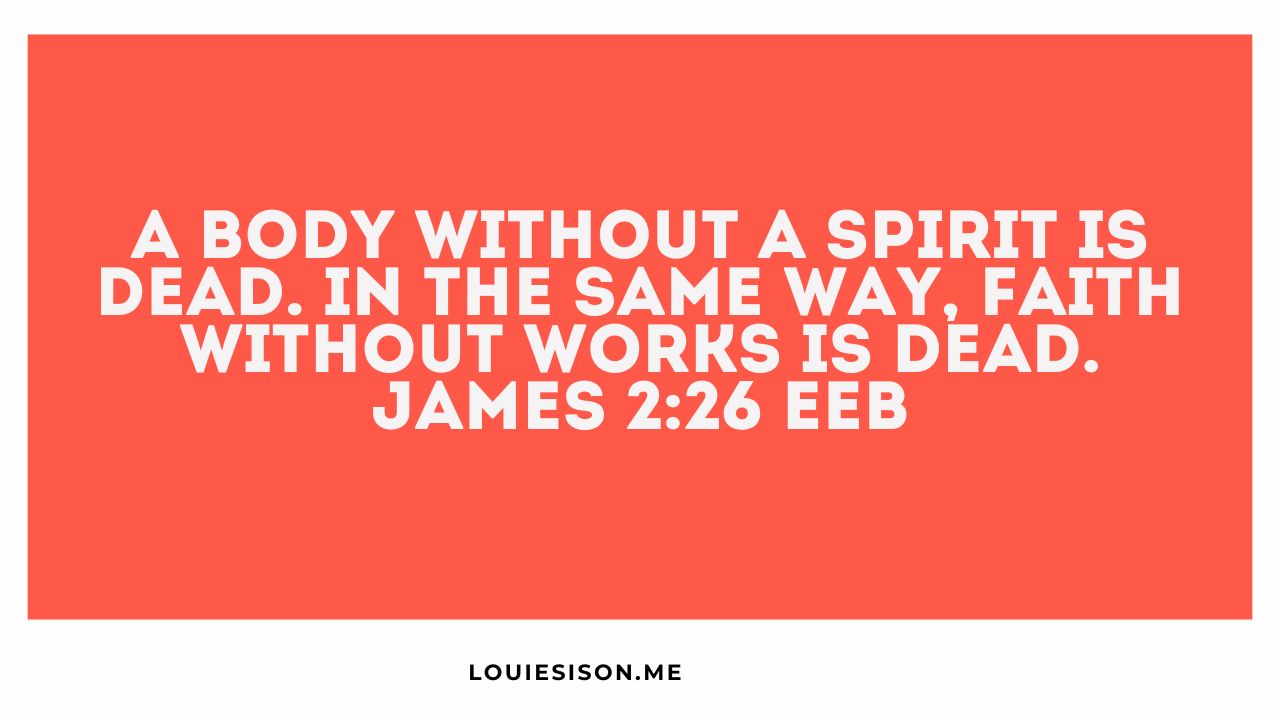
James 2:26 in the Easy English Bible says, “A body without a spirit is dead. In the same way, faith without works is dead.”
James does not ease you into that idea.
He does not build up to it carefully or soften the edges or give you a long theological runway before the landing. He just says it. Directly. With the kind of clarity that leaves very little room for comfortable misinterpretation.
A body without a spirit is dead.
You know what that looks like. You have seen it or you can imagine it. A body that was once alive, once moving, once full of warmth and breath and purpose, now still. Now cold. Now completely incapable of doing anything it was designed to do. Not because the body changed shape. Not because it looks different from the outside. But because the animating force that made it alive is gone.
James says faith without works is exactly that.
Not weak faith. Not immature faith. Not faith that needs a little more encouragement and a little more time to develop.
Dead faith.
And dead things do not produce living results no matter how sincerely they are believed in.
The Comfortable Christianity That James Is Dismantling
There is a version of faith that is almost entirely internal.
It lives in the heart and the mind and the prayer closet and the Sunday morning service. It believes the right things, confesses the right scriptures, attends the right gatherings, and feels genuinely moved by the presence of God in worship.
And then Monday arrives. And Tuesday. And the ordinary unremarkable days of the week where faith is not a feeling but a choice. Where belief is not measured by what you say in a service but by what you do in a situation. Where the rubber of everything you claim to trust God for meets the road of actually living as though you trust Him.
And for a lot of people, that is where the gap appears.
Not in what they believe. In what they do with what they believe.
James is not attacking genuine faith. He is exposing counterfeit faith. The kind that looks alive from the outside because it uses all the right language and shows up in all the right places but produces nothing in the actual lived experience of the person who holds it.
He is saying that kind of faith is not just incomplete. It is dead.
What Dead Faith Actually Looks Like
This is worth getting specific about because dead faith rarely announces itself as dead faith.
It looks like praying for a business breakthrough while consistently making decisions that contradict the breakthrough you are praying for. Asking God for financial freedom while spending in ways that guarantee financial bondage. Believing for open doors while never walking toward any of them.
It looks like confessing that God has a plan for your life while doing nothing to develop the gifts and skills and capacities that His plan is going to require of you. Speaking the promises while sitting still in a situation that has needed your courageous action for a long time.
It looks like telling God you trust Him and then living every day from a place of fear. Making every decision from scarcity. Holding everything so tightly that there is no room for His provision to move through your open hands because your hands were never open in the first place.
None of those people would describe their faith as dead. They would describe it as sincere. As genuine. As real.
And sincerity is not the question James is asking. The question James is asking is whether the faith is alive. And alive things move. Alive things produce. Alive things look different on the outside than they do if they were not there.
Faith Is the Engine. Works Are the Proof It Is Running.
Here is a distinction worth sitting with carefully.
James is not saying works save you. That is not the argument of this passage and it is important not to read it that way.
He is saying that genuine saving faith, the real kind, the alive kind, the kind that has actually taken root in a person’s heart and transformed the way they see God and themselves and the world, that kind of faith inevitably produces works.
Not as a condition of the faith. As evidence of it.
The way smoke is evidence of fire. The smoke does not create the fire. But if the fire is genuinely burning you will see the smoke. And if there is no smoke anywhere, at some point you have to ask honestly whether the fire you believe is burning is actually burning at all.
Works are the smoke. Faith is the fire.
And a fire with no smoke is worth examining.
Abraham Understood This Before James Wrote About It
James actually uses Abraham as his example in the verses surrounding this one and it is worth following his thinking there.
Abraham believed God. That belief was counted to him as righteousness. The faith came first. It was genuine and it was real and God honored it.
And then God asked Abraham to act on it.
To leave everything familiar. To go to a place he had never seen. To wait decades for a promised son. And then, most impossibly, to offer that son back to the God who gave him.
At every point Abraham’s faith was tested not in what he believed in his heart but in what he did with his feet. And at every point the works confirmed that the faith was alive. That it was not just a feeling or a confession or a theological position. It was a living, active, costly, real thing that moved him in directions he could not have moved on his own.
That is what alive faith looks like.
It moves you. It costs you something. It produces decisions and actions and a life that looks different than it would look if the faith were not there.
The Question This Verse Is Really Asking You
Not in a theological sense. In a practical, personal, Monday morning sense.
Where in your life right now is there a gap between what you say you believe and what you are actually doing?
Where are you confessing faith with your mouth while your actions are telling a completely different story? Where are you asking God to move while you are standing completely still in a situation that requires your movement? Where are you waiting for a miracle in an area where God has already given you everything you need to take the next step and is waiting for you to take it?
Those gaps are not just inconsistencies. According to James they are the places where your faith has gone cold. Where the body is present but the spirit has stopped animating it.
The good news is that dead things can come back to life.
Not by believing harder. By moving. By taking the step that the faith requires. By doing the thing that makes no sense apart from the God you claim to trust. By closing the gap between the confession and the conduct one courageous decision at a time.
Faith without works is dead.
But faith expressed through works is one of the most powerful forces on the face of the earth.
And it starts with whatever step you have been putting off taking.
Take it today.
Louie
Where is the gap between what you believe and what you are doing? Name it honestly. Then decide what one action would begin to close it. Do that thing before the week is over.